Buying guides
Tyre Inflator Buying Guide: Cords, Duty Cycle and Fit
By Samveg Jain · Updated 21 October 2026 · 5 min read
Some links on this site may be affiliate links. If you buy through them we may earn a commission, at no extra cost to you. It never changes what we recommend. How this works.
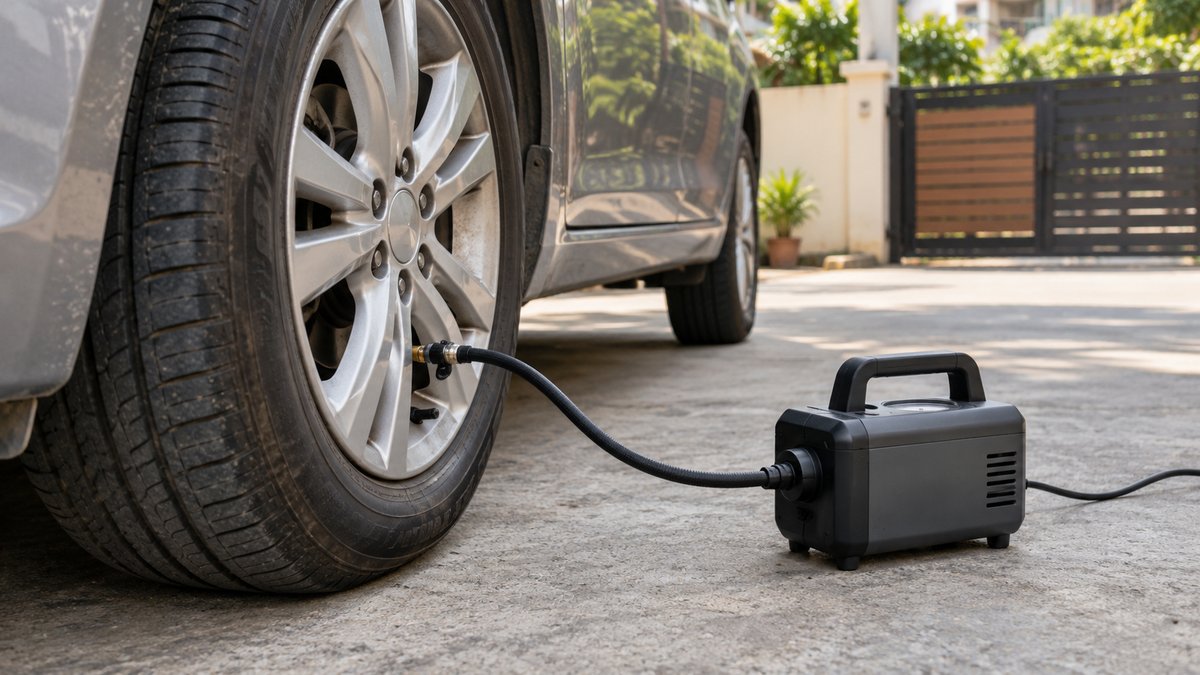
A useful tyre inflator reaches all your wheels, works from an approved power source and completes normal top-ups within its stated duty cycle. Choose around tyre size and the pressure adjustment you expect to make. Maximum pressure alone tells you little about speed, heat or convenience, and an inflator cannot make a damaged tyre safe.
Define the job before choosing the pump
Routine top-ups on a hatchback are different from filling a large tyre after substantial pressure loss. Ask for inflation-time information using a stated tyre size, starting pressure and target pressure. A demonstration filling a bicycle tyre or an already firm ball is not evidence of suitable car performance. Compare like-for-like tasks whenever the documentation provides them.
Think about where you will use it. A home driveway offers time and light; a narrow highway shoulder may offer neither. Carrying equipment does not create a safe repair location. If a tyre is visibly damaged or cannot hold pressure, arrange help rather than repeatedly inflating it and continuing. Our puncture-kit guide explains why roadside tools have limits.
Choose a power arrangement you can support
| Type | Practical advantage | Buying constraint |
|---|---|---|
| Vehicle socket powered | No separate pack to keep charged | Socket current limit and cable reach |
| Rechargeable cordless | Easy movement around the car | Available charge and permitted storage temperature |
| Higher-duty external supply | Options for more demanding tyre sizes | Approved connection and operating procedure |
Read the pump's input rating alongside the vehicle socket rating. A physically fitting plug does not establish electrical compatibility. Do not solve an overloaded socket by installing a larger fuse. For direct-connected equipment, check the manufacturer's instructions and seek help if the connection method is unfamiliar. Choose a different unit if safe use requires modifications you cannot support.
Measure cable and hose reach on your car
Measure from the permitted power point along a realistic route to the furthest wheel, including the valve when it sits near the top of the tyre. The hose should reach without the inflator hanging from the valve. Include the spare if you intend to check it, and consider where the unit can stand on a dry, stable surface.
A screw-on connector can feel secure but requires more handling; a lever connector may be quicker but needs room around the valve. Check compatibility with your wheels and valve arrangement. A flexible replacement hose is useful only if the supplier stocks the correct part. Prefer a bag that keeps the connector clean rather than leaving it loose beside gritty tools.
Read duty cycle and cooling instructions
Duty cycle describes permitted operation and rest under stated conditions. Look for the actual continuous run limit, required cooling interval and any temperature or pressure qualifications. Four consecutive tyre top-ups may exceed the allowance of a small pump even when each individual tyre needs little air. A thermal cutout is protection, not permission to run until shutdown every time.
Ask for practical performance at the pressures your vehicle uses. Free-air flow figures are not the same as airflow into a pressurised tyre. A larger unit is worthwhile only if its documented capability solves your task and you can store and power it safely. Weight, vibration and noise also affect whether you will use it regularly rather than leave it buried under luggage.
Separate an easy display from a dependable measurement
A backlit display and auto-stop are convenient, but extra decimal places do not prove accuracy. Check the claimed measurement tolerance, pressure units and whether the reading is taken while running or after the pump pauses. Compare its settled reading against a dependable gauge during the first uses, and investigate inconsistent readings instead of averaging them without a reason.
Use the car maker's pressure specification for your load and tyre configuration. NHTSA's tyre guidance explains the role of the vehicle placard and cold measurements. Keep that instruction accessible rather than relying on memory. Our digital gauge guide covers valve sealing, units and repeat readings.
Check safe operation and storage before purchase
- Confirm whether the unit is dry-use only and protect it from rain and standing water.
- Keep leads away from hot parts, sharp edges, pedals and moving components.
- Follow the specified vehicle operating state; never run an engine in an enclosed space.
- Allow a hot hose and compressor to cool before packing them against other luggage.
- Secure the stored unit so it cannot move into the passenger compartment.
A rechargeable model needs a maintenance routine and storage within its stated limits. Do not assume a parked car in Indian summer is suitable for every battery product. Check the warranty, replacement hose availability and instructions before buying. A product with a clear manual is easier to assess than one sold only through headline pressure and power claims.
Keep small sports-ball adapters separate from the tyre connector. A labelled accessory pocket reduces the chance of losing the valve fitting while unpacking other tools, and keeps unnecessary pieces out of the working area.
Test at home before relying on it away from town
Set up on level ground and practise a modest top-up when conditions are safe. Check reach, unit selection, stopping behaviour and removal of the connector. You should be able to use the controls without placing your face close to a hot hose or balancing the pump against the wheel. Recheck the pressure and put the valve cap back afterwards.
Plan its storage with the rest of your road-trip equipment. Keep emergency contact details and a recovery option available as well. The buying objective is a manageable routine for maintaining pressure, with a clear stopping point when the tyre needs professional attention.
What to look for when you buy
Socket-powered portable inflator
Input current compatible with the car, sufficient cable reach and a clear cooling schedule.
Rechargeable handheld inflator
Supported tyre sizes, useful top-up capacity, storage limits and an accessible charging routine.
Higher-duty portable compressor
Documented airflow at working pressure, compatible power connection and a suitable hose for larger tyres.
Frequently asked questions
Is the highest maximum pressure the best choice?
Not by itself. Practical inflation time, duty cycle, tyre compatibility and a secure valve connection matter more for normal car top-ups.
Should I use the pressure on the tyre sidewall?
Use the vehicle maker's specified cold pressures for the tyre and load configuration. The sidewall marking is not a universal target for the car.
Can an inflator repair a puncture?
It supplies air. A continuing leak, damaged tyre or rapid pressure loss needs proper assessment; adding air does not repair the cause.
Is auto-stop enough to trust the final pressure?
Check the result with a dependable separate gauge. Display precision and automatic stopping do not establish measurement accuracy.
More guides
Buying guides
Budget Car Accessories Worth Buying for Daily Use
Prioritise a tyre gauge, useful cloths, a torch and tidy storage before decorative gadgets. Buy for a recurring task and check fit before keeping it.

Buying guides
Car Air Purifier: Filter, Airflow and Running Costs
Choose a filter purifier with clear airflow evidence and available replacements. Remove odour sources and check safe mounting before buying.
Buying guides
Car Phone Holder Types Compared: Mount and Fit
Choose the attachment and phone grip separately, then test the complete setup from the driving position while parked.