Power & charging
Jump Starter vs Power Bank Jump Starter: Buying Fit
By Samveg Jain · Updated 21 October 2026 · 6 min read
Some links on this site may be affiliate links. If you buy through them we may earn a commission, at no extra cost to you. It never changes what we recommend. How this works.
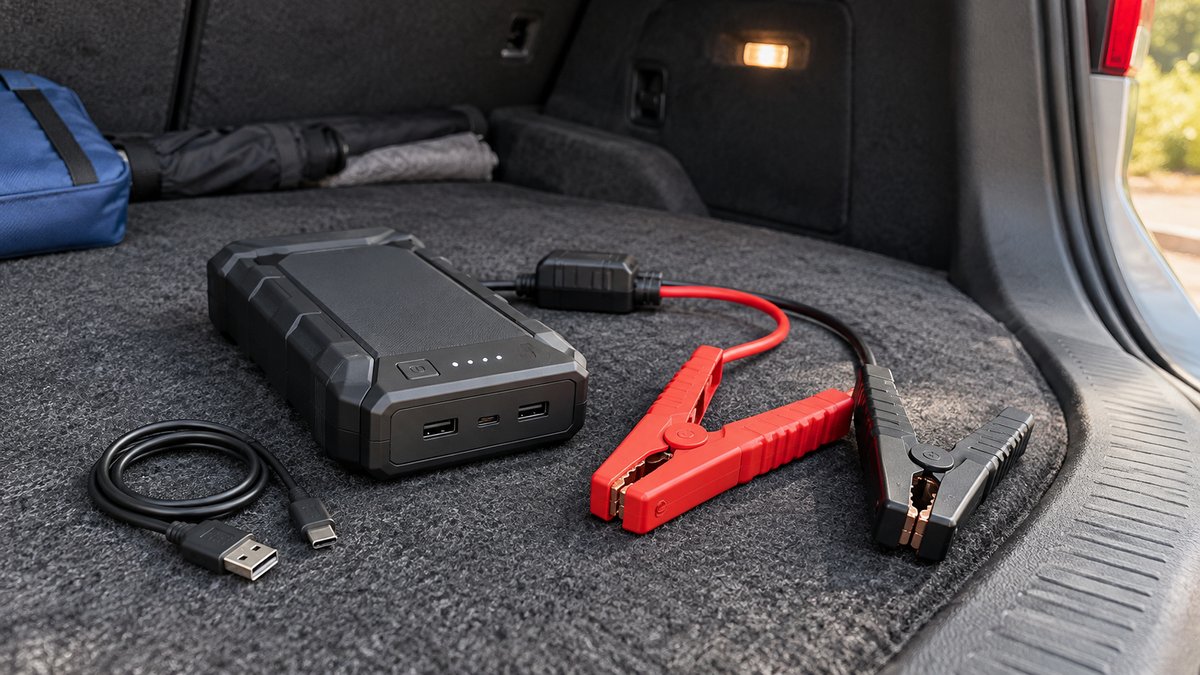
A portable jump starter and a power bank jump starter can serve the same starting purpose. The second description usually adds USB device charging to a jump-start pack. Buy on documented compatibility with your vehicle, protected clamps and storage requirements before comparing phone charging. An ordinary USB power bank cannot jump-start a car and must never be adapted to try.
Separate a starting pack from a phone battery
A jump starter is designed to deliver a brief high-current assist through its approved battery leads. A phone power bank supplies low-voltage electronics through USB. Their battery capacity labels may look similar, but the output hardware and intended loads are different. A shared word in the product name does not make the devices interchangeable.
Some jump-start packs include USB ports as a convenience. A jump-starter manufacturer's USB support guidance confirms this dual use exists. The useful comparison is between a dedicated starting pack and a starting pack with extra USB capability, rather than between a vehicle tool and an ordinary phone charger.
Do not infer suitability from a photograph of clamps included beside a generic battery box. Look for a manual that identifies supported vehicle batteries, engine limits and operating conditions. If the listing cannot explain which starting system the pack supports, it is a poor basis for an emergency-equipment purchase.
Compatibility comes before current claims
Confirm vehicle system voltage, supported battery chemistry, engine type and the maker's stated engine-size coverage. Diesel and petrol compatibility may differ within one pack's ratings. Hybrid and electric vehicles can have specific restrictions concerning low-voltage assistance and connection points. Follow the vehicle handbook rather than assuming any visible battery terminal is an approved place to connect.
Peak-current numbers are difficult to compare when sellers do not explain how they are measured. A large headline cannot replace a clear operating specification. Look for documented starting suitability under stated conditions, supported temperature ranges and the condition of the pack required for use. Choose according to your vehicle instead of the highest number on the page.
If the car has a battery fault, damaged wiring or a warning condition, starting assistance may not be appropriate. The vehicle and pack instructions must govern. This guide covers buying decisions rather than battery charging or connection steps, because those procedures depend on the exact equipment and vehicle arrangement.
Protection features need understandable instructions
Look for insulated clamps, sound lead construction and documented reverse-polarity, short-circuit and temperature protection. Read what the indicators mean and what happens when the pack refuses to operate. Protection claims are useful only if the user can recognise the state of the tool and respond correctly.
Avoid treating an override button as a stronger normal mode. Manufacturer override guidance shows that some override functions disable safety protections. A beginner should not select a pack because such a function sounds powerful. Seek appropriate assistance when normal protected operation will not proceed, and follow the manufacturer's instructions rather than bypassing a refusal.
Check that clamp jaws can be stored without touching exposed connectors. Leads should fit the case without being tightly bent at their entry points. A damaged lead is not something to repair with tape before an emergency. Confirm replacement accessories and local support are available for the exact pack.
What the USB feature changes
USB charging may be useful during a delay, but it uses the same stored energy intended for starting assistance. Decide whether the pack is primarily emergency reserve or a daily phone charger. If every trip begins with depleted emergency equipment, the extra feature has made the kit less dependable rather than more convenient.
Compare USB port type, stated output, compatible cables and the method used to recharge the pack. Do not assume that a USB-C-shaped port supports every charging function. Our car mobile charger guide addresses daily charging logistics, while the wireless charger guide covers grip and heat for a mounted phone.
A separate phone power bank can make sense if it keeps the emergency starting pack reserved and avoids carrying the larger tool into hotels. That adds another item to charge, so the choice depends on your habits. Count the equipment you will maintain, not merely the ports you receive in a bundle.
Heat, storage and routine checks
Indian parked-car heat makes storage limits a buying criterion. Read the stated storage temperature and do not assume the glovebox or boot remains within it. If the manufacturer does not permit the conditions your parked car experiences, choose a storage routine outside the vehicle rather than ignoring the limit.
Inspect the pack for swelling, damage, corrosion or unusual behaviour before use. Follow the maker's advice for inspection intervals and recharging. Keep its case away from loose metal tools, liquids and heavy luggage that can crush connectors. Check travel restrictions separately if you intend to carry the pack on an aircraft.
A purchase and ownership checklist
- Exact vehicle voltage, battery type and engine coverage are documented.
- The manual explains normal operation, warning indicators and prohibited uses.
- Clamps and leads have protected storage and suitable construction.
- Temperature limits match the planned storage routine.
- USB features and pack recharge requirements are stated clearly.
- Support, warranty and replacement accessories are available.
- A calendar reminder prompts checks before long journeys.
Add the pack to your trip preparation list only after establishing where it will be stored and how it will be maintained. Repeated starting trouble needs diagnosis, not an ever-larger pack. The useful purchase is compatible emergency equipment that is ready when needed, with phone charging treated as an optional secondary job.
What to look for when you buy
Dedicated portable jump starter
Documented engine and battery compatibility with protected insulated clamps.
Jump starter with USB outputs
The same starting suitability plus clearly stated USB output and charging specifications.
Protective storage case
Space for clamps and leads without pressure on connectors or exposed metal.
Frequently asked questions
Can an ordinary phone power bank jump-start a car?
No. A normal USB power bank is not designed to supply a vehicle’s starting current or connect to its battery.
Is a power bank jump starter a different category?
It is generally a jump starter with added USB device charging. Verify the starting specification rather than relying on the name.
Does a larger peak current guarantee better starting?
No. Compare documented compatibility, usable starting ratings, temperature limits and protection features.
Can I use it to charge the car battery?
A jump starter is for a brief starting assist where approved, rather than a substitute for a suitable battery charger or fault diagnosis.
More guides
Power & charging
A Charger for a Car Parked for Weeks: What to Check First
Choose a charger for a parked car by battery chemistry, voltage and maintenance mode, with connection checks and clear reasons to stop.
Power & charging
Car Key Fob Battery: Symptoms and Safe Replacement
Identify a weak key fob battery, confirm the exact coin cell and follow a careful replacement process without damaging the casing.
Power & charging
Car Battery Winter Care: Check Before Cold Mornings
Slow starts on cold mornings need diagnosis. Check battery condition, terminals and charging before choosing a compatible replacement.