Road trips
Festive Road Trips: Fuel Savings That Fit Real Family Travel
By Samveg Jain · Updated 26 October 2026 · 6 min read
Some links on this site may be affiliate links. If you buy through them we may earn a commission, at no extra cost to you. It never changes what we recommend. How this works.
Quick answer
For a less wasteful festive road trip, set cold tyre pressures to the vehicle's recommendation for the load, remove unnecessary luggage and drive at a steady, safe speed. Plan around predictable queues and use air conditioning according to comfort and visibility. Avoid overinflation, engine-off coasting and other fuel-saving tricks that reduce control.
Save fuel on a festive road trip by checking cold tyre pressures, carrying only useful luggage and driving smoothly at a safe, steady speed. Plan for likely queues and use the air conditioner to maintain comfort and clear glass. No single setting guarantees a saving across every Indian road, load or traffic condition.
The aim is to remove avoidable waste from an ordinary family journey. That starts before departure, when you can correct a low tyre or move an unnecessary bag without holding up the trip.
Set tyre pressure before the car warms up
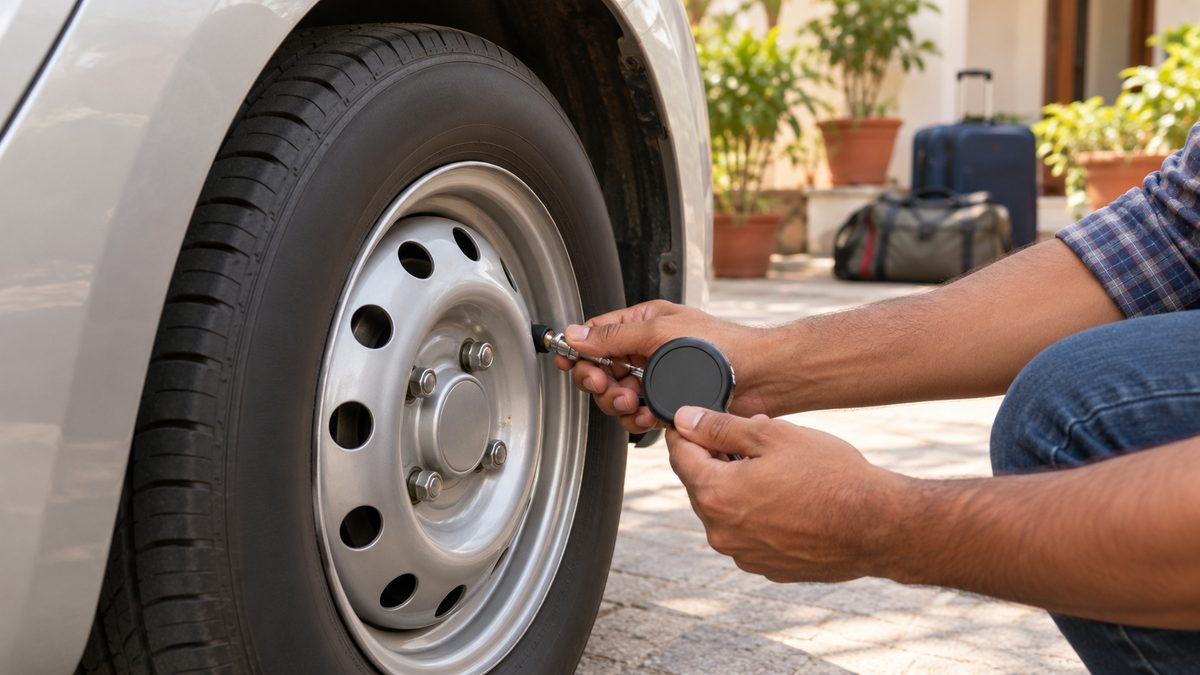
Check the handbook or vehicle pressure label for the recommended cold pressures. Look for any separate recommendation for a fully loaded car. Front and rear values may differ, so do not copy one wheel's reading to every tyre or use the maximum pressure moulded into the tyre sidewall as your target.
Measure before driving, following the handbook's cold-tyre guidance. Driving warms the tyres and raises their pressure; do not bleed warm tyres down to a cold specification. If a tyre repeatedly loses air, have it inspected rather than treating repeated top-ups as the solution.
Underinflated tyres can increase rolling resistance, while overinflating to chase economy can compromise tyre behaviour and wear. Use a suitable gauge and check the spare as specified. The tyre pressure gauge guide covers useful features, and the inflator buying guide explains power and reach checks.
Pack gifts without carrying the household
Empty the boot before packing. Remove tools, sports kit and other items left from earlier journeys, but retain the spare-wheel equipment, first-aid supplies and breakdown kit you need. Extra mass requires energy to move, especially through repeated stops and starts. Do not remove essential safety equipment for a marginal weight reduction.
Place heavier bags low and secure them so they cannot slide forward under braking. Keep the rear view clear and stay within the vehicle's load limits. An overloaded car is a handling and braking concern before it is an economy concern.
External carriers can add aerodynamic drag. Remove an unused roof carrier if the fitting instructions allow, and consider whether the luggage fits safely inside before installing one. Never move loose bags into passenger footwells or onto laps simply to avoid a roof load. Use the road trip packing list for India to decide what earns its space.
Choose a departure plan that survives festive queues
Check current route conditions and official traffic advice before leaving. A slightly longer flowing route may use less fuel than a shorter congested one, but distance alone cannot settle the comparison. Consider road condition, closures, safe stops and how tired the driver will be.
Allow time for meals, toilets and fuel rather than trying to recover every delay by accelerating harder. Group errands before joining the main route, and agree on the first rest stop with passengers. Do not choose an unfamiliar isolated shortcut solely because a map predicts a small time saving.
Have a passenger monitor changes where possible, or stop safely before adjusting the route. The Diwali traffic driving tips cover the congestion side of the journey. For driving restrictions and speed limits, check the current rules where you drive.
Keep a gap that reduces unnecessary braking
Look well ahead and leave enough space to respond gently when traffic slows. Smooth acceleration and early, controlled slowing help avoid wasting energy in repeated bursts followed by hard braking. Maintaining a gap does not mean obstructing traffic or resisting a necessary stop.
Choose a speed suited to the road, visibility and posted limit. High speed increases aerodynamic resistance, but no universal fuel-saving speed fits every car and road. Do not follow a lorry closely to reduce drag; the lost view and stopping space create a serious risk.
In a manual car, change gear without labouring the engine, using the handbook's guidance and the response of the car. Leave an automatic in its recommended driving mode. Never coast downhill with the engine off or select neutral as a fuel-saving technique; preserve control and use suitable engine braking.
Use cooling for passengers and visibility
Air conditioning uses energy, but switching it off at any cost is a poor plan in a hot, crowded cabin. If the car has been parked in the sun, release trapped hot air briefly before cooling, provided outside air and surroundings are suitable. Close the windows once the cabin is cooling.
Use a comfortable temperature rather than repeatedly alternating between maximum cooling and no cooling. At higher road speeds, open windows can add drag, so the windows-versus-AC question has no single answer. Keep the driver comfortable and alert, and use demisting whenever needed.
Recirculation can help maintain cooling, but reassess it if the cabin becomes stuffy or glass mists. In smoky traffic, follow the post-Diwali cabin air advice. Do not idle in an enclosed parking area to cool the car.
Make these checks before setting off
- Set cold tyre pressures for the planned load and investigate any recurring loss.
- Secure luggage, check load limits and keep safety equipment accessible.
- Review the route, fuel options and places for a proper break.
- Check warning lights, fluid levels and scheduled maintenance before a long drive.
- Resolve dragging brakes, poor running or unusual fuel consumption with a workshop.
Use the pre-trip inspection checklist if the car has been standing or a service is due. A sound vehicle and an unhurried driver offer a better basis for an efficient trip than watching the instant economy display while traffic changes ahead.
What to look for when you buy
Tyre pressure gauge
A clear display, the units used on your vehicle's pressure label and a valve connector that seals reliably.
Portable tyre inflator
Compatibility with the car's power supply, a suitable duty cycle and a hose that reaches every wheel.
Boot organiser or luggage restraints
Secure attachment to approved points and a size that leaves essential safety equipment accessible.
Frequently asked questions
Will premium fuel automatically improve economy?
Use the grade specified in the handbook. Paying for a different grade does not guarantee better economy in an engine designed for the recommended fuel.
Can I rely on the range display to reach the next fuel stop?
Treat it as an estimate that changes with conditions. Leave a reserve and identify suitable stops before a remote stretch, rather than depending on the final displayed distance.
Are fuel-saving additives worth packing?
Do not add an unapproved treatment for a promised saving. Follow the vehicle's fuel and maintenance guidance, and ask a workshop about a specific running problem.
Does cruise control always save fuel?
It can help maintain speed on suitable open roads, but traffic, hills and system behaviour affect the result. Use it only where conditions and the handbook support safe operation.
How should I compare economy between two trips?
Use distance travelled and fuel added over comparable refill cycles. Note load, traffic and route differences. A short dashboard reading or one downhill stretch is a poor basis for comparison.
More guides
Road trips
Diwali Traffic Driving Tips for Crowds, Smoke and Delays
How to prepare for a slow festive journey and give yourself room to react when crowds and smoke change the road ahead.
Road trips
Car Seat Cushions: Fit Checks for Long Drives
Check cushion thickness, belt routing, pedal reach and airbag clearance before adding seat padding or lumbar support for a long drive.
Road trips
Pre-Trip Car Inspection: Mechanical Checks Before Travel
Check fluids, tyres, lights and brake behaviour before Diwali or wedding-season travel, with time to repair faults before departure.