Safety gear
Car Fire Extinguisher: Type, Bracket and Access
By Samveg Jain · Updated 21 October 2026 · 5 min read
Some links on this site may be affiliate links. If you buy through them we may earn a commission, at no extra cost to you. It never changes what we recommend. How this works.
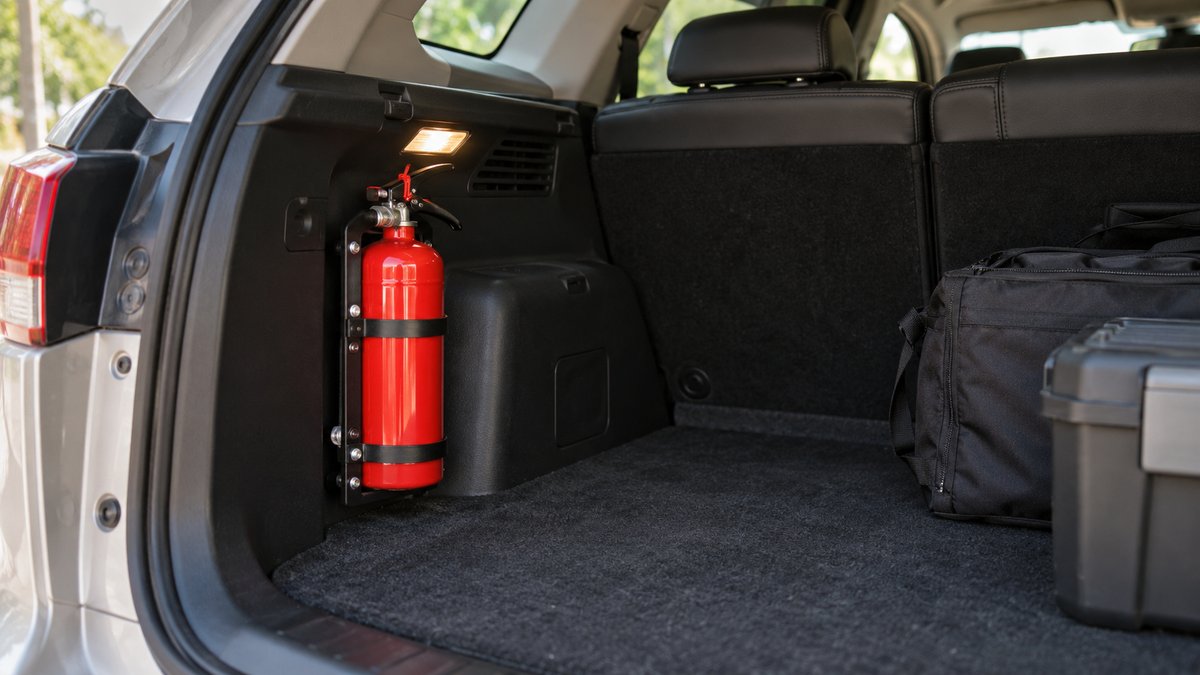
Choose a car fire extinguisher by documented suitability for the vehicle, applicable fire classes, service support and a secure bracket. Cylinder size alone is not a buying decision. For a suspected vehicle fire, getting everyone out and calling emergency help take priority. Carrying an extinguisher does not create an obligation to approach a burning vehicle.
Begin with the emergency plan
The US Fire Administration's vehicle-fire guidance tells occupants to stop safely, turn off the engine, leave the vehicle and keep away. It advises against opening a bonnet or boot when fire is suspected there. Do not retrieve luggage or a buried extinguisher before leaving. Equipment should support a safety plan, not delay evacuation.
Tell passengers how to open doors and exit the car. Keep emergency contacts available and check the relevant local emergency numbers for your route. If the vehicle uses an alternative fuel or a traction battery, communicate that to responders. Do not assume an ordinary small extinguisher can control every energy source or a fire that appears to have gone out.
Read the class and standard together
Fire classifications are not identical across countries. A letter on an imported listing can mean something different from a familiar local description. Read the full approved standard, the manufacturer's explanation and suitability for the expected hazards. Seek advice from a qualified fire-equipment supplier when the label or application is unclear, rather than combining advice from incompatible classification systems.
Dry-powder extinguishers are commonly considered for mixed hazards, but suitability still depends on the documented rating and use conditions. Powder also creates residue and visibility problems. Other agents have different limitations. Do not select equipment from colour, cylinder shape or a seller's statement that it works on everything. Ask for documentation for the actual unit offered for sale.
Compare complete equipment packages
- A vehicle-suitable powder cylinder with a matching bracket provides a documented starting package. Verify the agent, relevant fire classes, service arrangements and environmental limits before ordering.
- An extinguisher sold without a bracket leaves a second buying task. A generic strap may not restrain its weight or release it predictably when needed.
- A compact aerosol-style product needs careful review of its approvals and intended role. Do not assume its small package is equivalent to a rated extinguisher.
- A serviced replacement cylinder may suit an existing installation only when its dimensions, mass and bracket compatibility are confirmed. Similar-looking bottles are not automatically interchangeable.
Solve mounting before paying
A cylinder is a heavy object and needs proper restraint. Choose a bracket designed for that extinguisher and an installation position approved for the vehicle. Avoid loose placement under a seat, inside a door pocket or on the parcel shelf. The location must preserve seat travel, pedal clearance, airbags, belts and safe passenger entry and exit.
Check the manufacturer's instructions and ask the vehicle maker or a competent installer about attachment points. Do not drill blindly into floors, seats or cargo panels. Hidden wiring, fuel components and structural requirements matter. If no appropriate mounting arrangement exists for the selected cylinder, choose another size or installation plan rather than improvising with household hooks or elastic cords.
Test access in the loaded car
Once installed, check the release while stationary and without discharging the cylinder. Can the intended user recognise the latch and remove the unit without moving luggage? Does the handle clear surrounding trim? Refit it correctly and check that it cannot rattle loose. Access should remain possible with the seats in their normal passenger positions.
Use the boot organiser guide to keep ordinary cargo away from the bracket. Do not treat organiser fabric as a mounting surface unless explicitly approved for that use. Add a reminder to the road-trip packing list so holiday bags do not conceal equipment that was accessible during daily driving.
Examine storage and service requirements
Check operating and storage temperature limits against the car's conditions. Look for readable instructions, serial or batch identification and service information. Where a pressure indicator is fitted, learn its permitted range from the manufacturer. An indicator alone does not establish the condition of every internal component or prove the unit remains serviceable indefinitely.
Arrange inspection and replacement at the intervals stated for the product and local rules. Record those dates with the vehicle documents. After any discharge, even a short one, follow the maker's service procedure before returning the extinguisher to use. Do not attempt a home refill or transfer agent between cylinders. Replace damaged or corroded equipment through an appropriate supplier.
Ask these questions at the counter
- Which standard and fire classes apply to this exact unit, and are its documents available? Confirm that advice refers to your local classification system.
- Is automotive storage explicitly allowed within a stated temperature range? An indoor building extinguisher is not automatically suitable for permanent use inside a hot car.
- Which bracket fits this cylinder, and who can assess the proposed vehicle mounting point? Include installation and future access in the buying decision.
- Where can the unit be inspected, serviced or replaced? Obtain a clear answer before choosing an unfamiliar cylinder with no nearby support.
- What does the maker require after damage, temperature exposure or partial discharge? Keep that information accessible rather than relying on a seller's verbal reassurance.
Keep the purchase within its limits
Training from a competent provider is more useful than practising around a real emergency. Understand when to withdraw and leave intervention to responders. Do not approach smoke, fuel leaks or a developing fire to justify the purchase. A visible exit route and safe conditions are essential, and conditions can deteriorate faster than a person expects.
Complete the wider setup with the roadside safety-kit guide, while remembering that any roadside action must be safe in the actual traffic conditions. A correctly selected, maintained and mounted extinguisher is one part of preparedness. Evacuation remains the first response when the vehicle itself is burning.
What to look for when you buy
Vehicle-suitable dry-powder extinguisher
Documented fire classes, service support and vehicle temperature suitability.
Rated vehicle mounting bracket
Compatibility with the cylinder and a vehicle-approved mounting location.
Serviced replacement cylinder
Traceable manufacture, inspection details and readable instructions.
Frequently asked questions
Can I keep an extinguisher loose in the boot?
No. Use an appropriate bracket and a suitable approved mounting location.
Does a small extinguisher make every car fire manageable?
No. Leave the vehicle, get clear and call emergency services; never attempt an unsafe intervention.
Are all fire-class letters identical worldwide?
No. Read the stated standard and local classification rather than translating letters from another country.
Can an extinguisher handle a traction-battery fire?
Do not assume a small consumer extinguisher can control one. Keep away and tell responders the vehicle type.
More guides

Safety gear
Car Safety Around Firecrackers: Parking for Diwali
A practical parking and inspection plan for Indian car owners before and after Diwali celebrations.
Safety gear
Night Driving Checklist: Lights, Glare, Fatigue and Kit
Prepare for an evening drive with checks for lights, glass, mirror glare, fatigue and breakdown equipment, plus clear reasons to delay.
Safety gear
Tyre Tread Depth: Check Wear Before Buying Replacements
Inspect tread grooves, wear indicators and uneven wear before choosing replacement tyres. Know when a professional inspection cannot wait.