Buying guides
Plug-in Hybrid SUVs: What Indian Buyers Should Check
By Samveg Jain · Updated 2 November 2026 · 6 min read
Some links on this site may be affiliate links. If you buy through them we may earn a commission, at no extra cost to you. It never changes what we recommend. How this works.
Quick answer
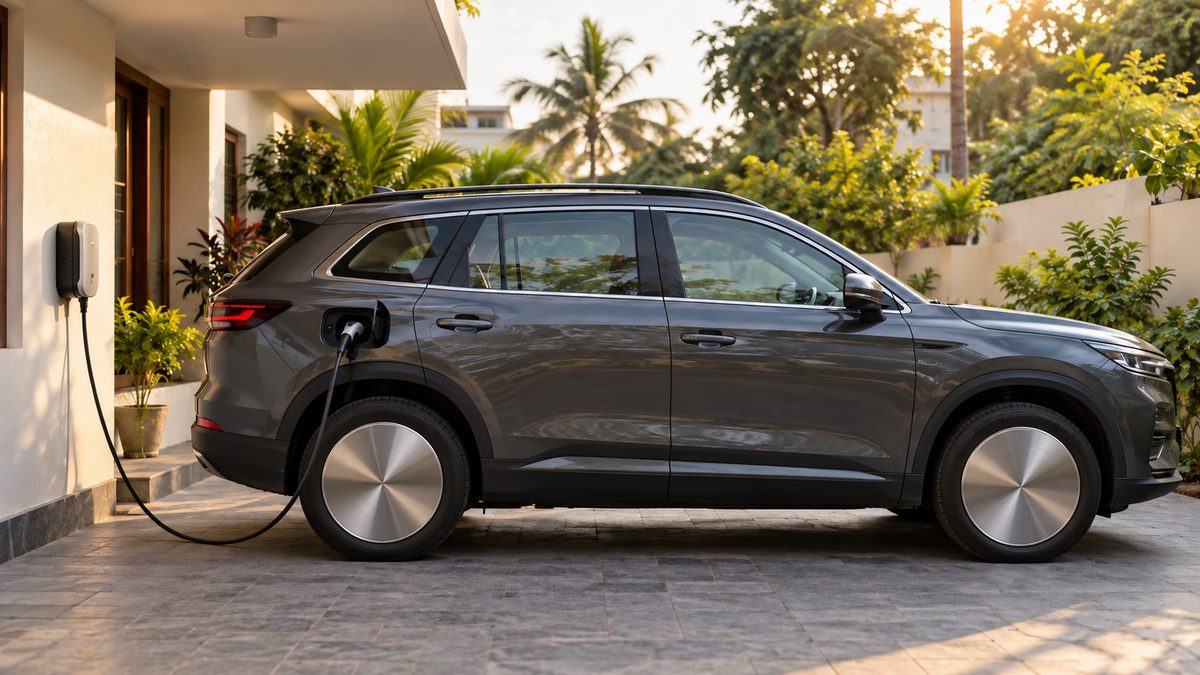
A plug-in hybrid has an engine and an electric drive system, with a battery you can charge externally. It suits buyers who can charge regularly and use electric driving for everyday trips while retaining petrol for longer journeys.
A plug-in hybrid SUV, or PHEV, combines a petrol engine with an electric drive system and a battery you can recharge from an external supply. It is most useful when you can charge regularly and cover much of your everyday driving on electricity, while keeping petrol available for longer trips.
Reports about JSW Motors’ first SUV have brought this choice into focus for Indian buyers. Before treating it as a convenient middle ground, check the part that happens at home: where the car will stand, how it will charge and how often you will plug it in.
What the reported JSW SUV tells us so far
October 2026 reports said JSW Motors, the JSW Group’s passenger vehicle arm, would launch its first SUV in India in early December 2026. Reports differ between December 3 and December 4. These are reported plans, not confirmation from JSW.
The SUV is reportedly expected to be based on the Jetour T2, with a plug-in hybrid system combining a 1.5-litre turbo-petrol engine, an 18.4 kWh battery and two electric motors. Assembly is reported for Chhatrapati Sambhajinagar, Maharashtra. Many reports use the name Combat, but that name is not official.
No price has been announced. Avoid building a purchase decision around estimates or assuming overseas specifications will match the Indian car. Our JSW Motors first-car report separates the reported details from questions still awaiting confirmation.
How a PHEV differs from a hybrid and an EV
A conventional hybrid uses its engine and recovered braking energy to manage a battery that you do not plug in. A PHEV adds external charging and generally a larger battery, allowing a longer stretch of electric driving. A battery electric vehicle has no petrol engine and depends on stored electrical energy.
| Type | Where driving energy comes from | Ownership question |
|---|---|---|
| Conventional hybrid | Fuel, with braking energy recovered into its battery | Does it suit your routes without needing a plug? |
| Plug-in hybrid | Fuel and externally charged electricity, plus recovered braking energy | Can you charge often enough to use its electric capability? |
| Battery electric vehicle | Externally charged electricity, plus recovered braking energy | Can your home and journey charging cover all your trips? |
Electric-only operation is not an unconditional promise. A PHEV’s engine may start because of acceleration demand, battery conditions, cabin heating or the selected mode. Ask the dealer to explain the specific car’s behaviour and demonstrate it during a drive.
Test the fit against an ordinary working week
Write down your commute, school runs, shopping stops and weekend journeys. Include diversions and the days when the car stays away overnight. Compare that pattern with the officially stated electric range, leaving room for air conditioning, traffic, speed and load to change the result.
A buyer with a fixed parking bay and regular overnight charging can start many days with usable battery charge. Someone using changing roadside parking may struggle to plug in at all. In that case, compare a conventional hybrid rather than assuming a PHEV will deliver the same benefits without charging.
Do not compare only petrol consumption from a charged-battery demonstration. Ask what consumption looks like after the externally supplied charge is used, and account for the electricity needed to replenish it. Compare similar journeys and include both energy sources in your own running-cost notes.
Ask about charging before paying a booking amount
Find out which charging methods the Indian version supports. An external socket does not mean every public charger will work, and you should not assume DC fast charging is included. Ask for the connector type, AC charging capability, supplied equipment and installation requirements in writing.
Charging time depends on the car’s onboard charger, the supply and the equipment, not just the battery size. Have a qualified electrician or approved installer assess your actual parking location. Use our PHEV home charging checklist before agreeing to an installation.
Make the test drive answer ownership questions
- Try the car with the family and luggage you normally carry. Check rear-seat access, boot space and where the charging cable lives.
- Drive in electric and hybrid modes where available. Notice engine starts, low-speed control and braking feel.
- Request battery and vehicle warranty documents. Check exclusions, service requirements and how a battery concern is assessed.
- Identify the workshop that can handle the high-voltage system and ask how roadside recovery is arranged.
- Read the handbook’s towing and charging instructions before taking delivery.
Keep routine checks in the plan too. A petrol engine still needs its scheduled care, while tyres must carry the vehicle at the handbook’s specified pressures. The pre-trip inspection checklist helps you build a routine around the whole car.
Choose the charging habit before the drivetrain
A PHEV can suit a household that wants electric local driving and makes occasional long journeys where charging stops are inconvenient. It asks for both a charging routine and engine servicing. If either feels impractical, compare other drivetrains before committing.
Use confirmed Indian specifications, a site assessment and a representative test drive as the basis for your decision. For equipment installation and road use, check the current rules where you drive. A rising launch story is a reason to ask better questions, not to skip them.
What to look for when you buy
Home charging assessment
An installer survey of your parking bay, electricity supply and the car’s charging requirements.
Approved charging cable
Written compatibility with the vehicle and charging equipment, plus sufficient reach without an extension.
Tyre pressure gauge
A clear display and compatibility with the pressures specified for the loaded vehicle.
Frequently asked questions
Can I buy a PHEV before my home charger is installed?
Ask for a site survey first and a firm installation plan before delivery. A sales assurance that any socket will work is not a substitute for checking your own parking space.
Will a PHEV work during a power cut?
A power cut stops home charging. Driving depends on the charge and fuel already in the car and the vehicle’s operating instructions; do not assume the car can power your home.
Does a larger battery make every PHEV better?
No. Compare usable electric range, vehicle weight, passenger space and charging time against your journeys. Battery capacity alone does not tell you how useful the car will be.
Should I wait for the reported JSW SUV?
Wait for official specifications and a test drive if that vehicle interests you. Reports cannot settle equipment, warranty, service arrangements or the final launch date.
Can I treat the fuel tank as emergency backup and ignore it?
Follow the handbook’s guidance on fuel use and storage. Petrol and engine maintenance still need attention even if most local journeys use electricity.
More guides

Buying guides
Boot Organisers for Festive Shopping Trips
Pack festive shopping low and securely, choose a boot organiser that fits your car, and keep emergency equipment accessible between shopping stops.
Buying guides
JSW Motors First Car in India: Reports and Buyer Checks
An expected SUV, a likely plug-in hybrid and a reported launch target: separate those reports from the details buyers still need in writing.
Buying guides
Budget Car Accessories Worth Buying for Daily Use
Prioritise a tyre gauge, useful cloths, a torch and tidy storage before decorative gadgets. Buy for a recurring task and check fit before keeping it.